
Crawl Space Vapor Barrier in Yorba Linda, CA
A crawl space vapor barrier is a heavy-duty polyethylene sheet installed across the ground and walls of your crawl space to block ground moisture before it enters the air your home breathes. Most Yorba Linda homes with a vented or dirt-floor crawl space need one – without it, the soil beneath your house releases moisture year-round, and that moisture migrates upward into your subfloor, insulation, and living space. At Topside Attic Insulation Yorba Linda, we install vapor barriers as part of our Crawl Space Encapsulation & Vapor Barrier services, following a documented, written-scope process that tells you exactly what you’re getting before anyone lifts a tool. Call us at (909) 323-1675 or read on to see what the work involves, what it costs, and what questions you should be asking any contractor before you hire them.
Vapor barrier work in Yorba Linda falls under our broader Crawl Space Encapsulation & Vapor Barrier in Yorba Linda service. The barrier itself is the foundation of that system – a full encapsulation job adds wall coverage, seam taping, and sometimes conditioned air or a dehumidifier, but it always starts with getting the ground plane right. If you’ve been quoted an encapsulation job that skips the vapor barrier or treats it as an optional add-on, that’s a scope worth questioning. Under our Haven Standard, the written scope you receive before any work starts will specify material thickness, seam overlap, and how penetrations are handled – not just a line that says “vapor barrier installed.”
When You Need a Crawl Space Vapor Barrier
Not every crawl space symptom points to a vapor barrier problem, but these specific conditions in Yorba Linda homes usually do:
- Visible condensation on HVAC ducts or floor joists. In Yorba Linda’s late-summer humid spells, warm moist air rising from an unprotected dirt floor contacts the cooler wood and metal above it. If you see droplets or dark staining on joists, the ground is the first place to look.
- A musty odor that appears after the first winter rains. Yorba Linda sits in the foothills northeast of Anaheim, and when seasonal rains return in November and December, crawl spaces with no vapor barrier act like sponges. The smell usually shows up in carpets and lower cabinets before homeowners trace it to the crawl space.
- Wood rot or soft spots in the subfloor. Persistent ground moisture over several years breaks down OSB and plywood subflooring from below. If a contractor is telling you to replace subfloor without first addressing the moisture source, the repair is likely to fail again.
- Higher-than-expected summer utility bills. An unprotected crawl space lets humid air enter the building envelope continuously. Your air conditioner works harder because it’s removing moisture, not just heat. Homes in the Black Gold Country Club and East Lake Village neighborhoods of Yorba Linda that we’ve assessed have shown crawl space moisture as a contributing factor in high cooling loads more often than homeowners expect.
- Pest activity in the crawl space. Subterranean termites and certain rodents are drawn to damp soil and soft wood. A dry, barrier-covered crawl floor is a less hospitable environment. We’re not pest control operators, but the condition of the vapor barrier is always part of what we document during an assessment.
- An existing vapor barrier that’s torn, displaced, or under six mils thick. Older Yorba Linda homes sometimes have a thin poly sheet that was installed decades ago – torn by HVAC technicians crawling through the space, buckled by soil movement, or simply too thin to do the job. A 6-mil sheet placed loose on the ground with no seam overlap is not a functioning vapor barrier.
Our Crawl Space Vapor Barrier Process
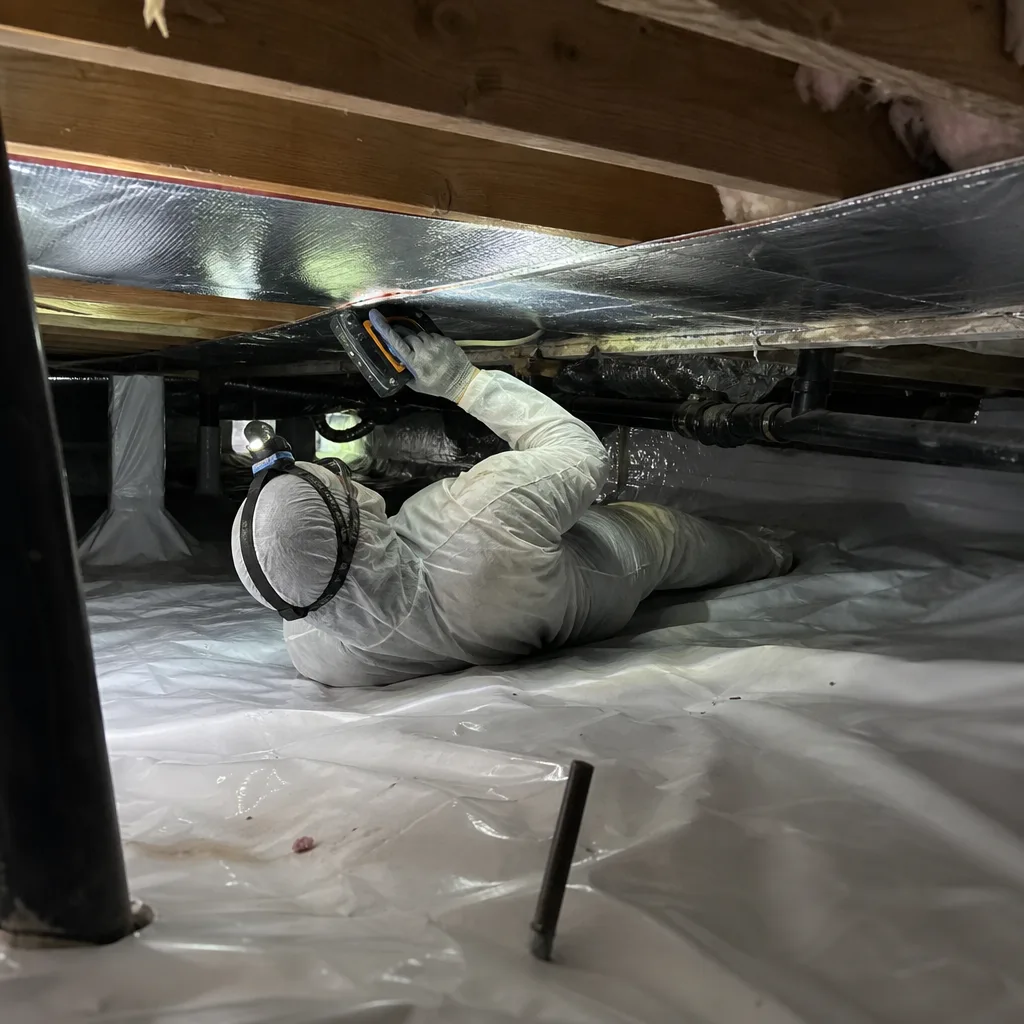
Every job follows the same sequence. We don’t skip steps to compress a schedule, and we don’t start installing material until the prep work is done. Here’s what the process looks like from the moment we schedule your job to the moment we hand over the photo record:
- Pre-installation moisture and condition assessment. Before we quote a single square foot of material, a technician measures crawl space humidity with a calibrated hygrometer, photographs existing conditions – torn poly, standing water, joist staining, insulation in contact with soil – and checks vent placement. In Yorba Linda’s older tracts, particularly homes built before 1990 in the Fairmont Village and Camino de Bryant corridors, we regularly find fiberglass batt insulation that’s fallen directly onto damp ground. We document all of it. The written price you receive is based on actual conditions, not a per-square-foot average applied without looking.
- Written price and scope delivered before any work starts. Under Haven Standard Clause 1, you receive a flat price, a written scope specifying material thickness (we typically use 12-mil reinforced polyethylene, with 20-mil available for crawl spaces with active drainage issues), seam overlap dimension, and how plumbing and post penetrations will be handled. No work begins until you’ve reviewed that document. This is not a courtesy – it’s the baseline for how we operate.
- Debris removal and ground prep. Rocks, construction debris, old insulation that’s fallen to the ground, and any existing deteriorated poly are removed before new material goes down. Installing a new barrier over debris creates puncture points that defeat the system within a season.
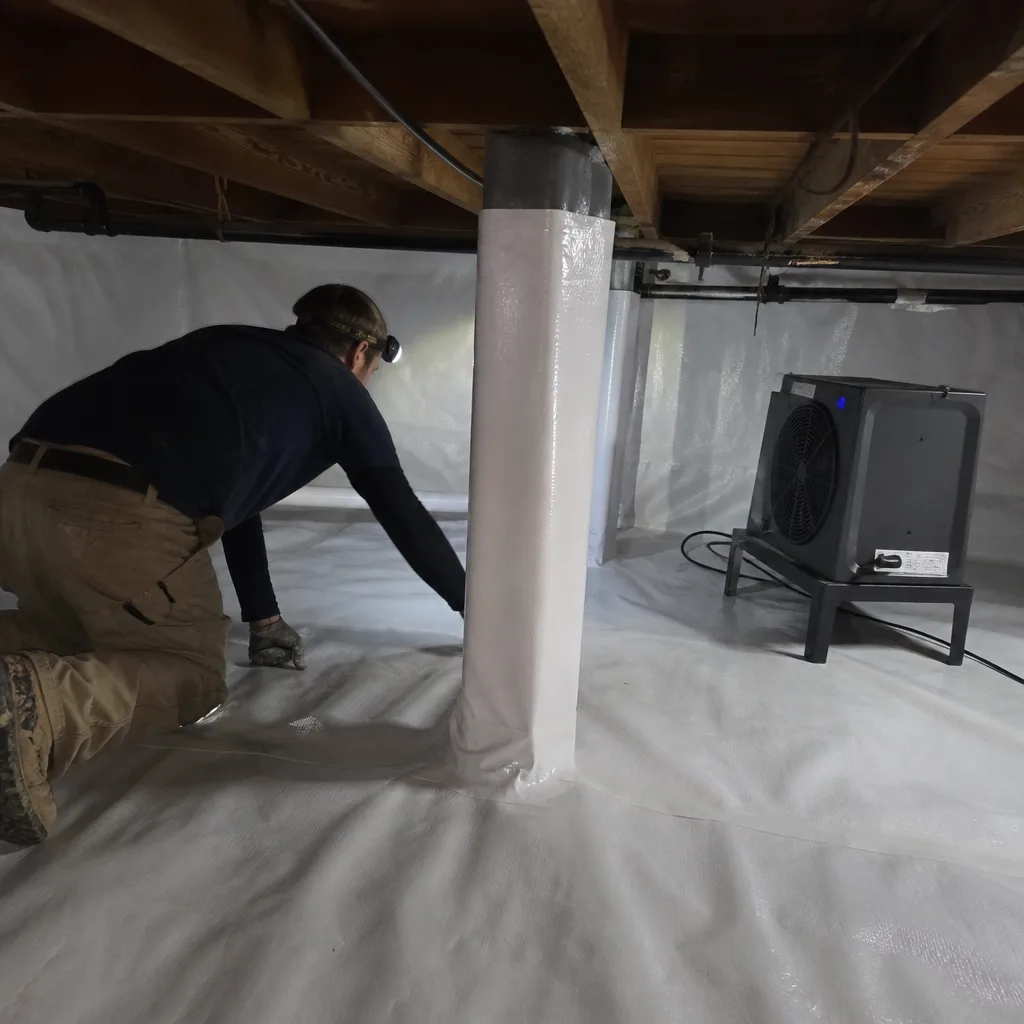
- Barrier installation with sealed seams and secured perimeter. We install the poly in overlapping runs – minimum 12-inch overlap at seams, taped with a compatible seam tape – and secure the perimeter to the foundation wall using mechanical fasteners rather than adhesive alone. Piers and structural posts are wrapped and sealed individually. The goal is a continuous ground plane with no gaps that moisture can travel through. For jobs that are part of a full encapsulation, the ground barrier ties into the wall liner so there’s no open joint at the footing.
- Penetration sealing and final inspection. Every pipe, post, and conduit that passes through the barrier gets sealed. We do a visual and physical inspection of the completed installation before we pack up – checking for bridging at piers, tension on seams, and perimeter attachment. If something doesn’t look right, it gets fixed before we leave, not flagged as a punch-list item.
- Documented photo record delivered at job close. You receive a photo record showing pre-installation conditions and post-installation coverage. This is included on every visit – not available on request. The record serves as your documentation if a home inspector, buyer’s agent, or insurance adjuster ever asks about the crawl space condition.
Crawl Space Vapor Barrier Pricing in Yorba Linda
Crawl space vapor barrier installation in Yorba Linda typically runs between $1,200 and $3,800 for a standalone barrier job. A full encapsulation that includes wall liner, sealing, and dehumidification runs higher – see our Crawl Space Encapsulation & Vapor Barrier in Yorba Linda page for those figures. The ranges below reflect what we’ve actually quoted in this market:
| Crawl Space Size | Material Spec | Typical Range |
|---|---|---|
| Under 1,000 sq ft | 12-mil reinforced poly, taped seams | $1,200 – $1,800 |
| 1,000 – 1,800 sq ft | 12-mil reinforced poly, taped seams | $1,700 – $2,600 |
| 1,800 – 2,800 sq ft | 12-mil reinforced poly, taped seams | $2,400 – $3,800 |
| Any size with active drainage or standing water history | 20-mil reinforced poly + drainage board | Add $400 – $900 |
Several factors move a quote toward the lower or upper end of those ranges:
- Access difficulty. Yorba Linda homes built on sloped lots in the Kerrigan Ranch and Hidden Hills areas sometimes have crawl spaces with clearances under 18 inches. Restricted access adds labor time and affects price.
- Debris and old material removal. If there’s a deteriorated barrier, fallen fiberglass, or construction debris, removal is priced into the scope – not discovered on install day.
- Number of penetrations. Homes with older plumbing that includes multiple drain lines, gas lines, and conduit runs through the crawl space take longer to seal correctly. A 1,500 square foot crawl with 20 pipe penetrations takes more time than one with four.
- Moisture conditions at time of installation. If standing water is present, it needs to be addressed before barrier installation. We’ll note this in the assessment and scope it separately.
If you’ve already received a written estimate from another contractor, we’ll review it with you at no charge – that’s our Free Second Opinion offer. Bring the quote; we’ll tell you whether the spec is correct for your conditions and whether the price is in line with what the Yorba Linda market looks like right now.
FAQs – Crawl Space Vapor Barrier
How thick should a crawl space vapor barrier be in Yorba Linda?
For most Yorba Linda crawl spaces, a 12-mil reinforced polyethylene barrier is the correct minimum – thin enough to work around obstacles, thick enough to resist puncture from normal crawl space traffic and minor debris contact. Homes with a history of standing water, active soil drainage issues, or high seasonal moisture readings should use 20-mil material. California’s Title 24 energy code requires a vapor retarder in unventilated crawl spaces, but the code’s minimum spec – 6 mil – is below what we recommend based on actual performance. For better thermal performance, consider adding Crawl Space Insulation alongside your vapor barrier. A 6-mil sheet installed without taped seams and mechanical perimeter attachment will degrade and shift faster than the home’s next HVAC service call. Call us at (909) 323-1675 and we’ll assess your specific crawl space and give you a written recommendation with pricing before any commitment.
Does a vapor barrier also stop radon in Yorba Linda homes?
A properly installed, sealed vapor barrier does reduce radon entry from soil, but it is not a radon mitigation system on its own. Radon mitigation requires sub-slab or sub-membrane depressurization – a pipe and fan system that draws soil gases out before they can enter the structure. If your home has tested above the EPA action level of 4 pCi/L, the vapor barrier is a useful part of the solution, but you’ll need a licensed radon mitigator to complete it. We’ll note elevated-risk indicators during our crawl space assessment and recommend testing if conditions warrant it. The good news is that a quality vapor barrier job and a radon mitigation rough-in can often be scoped and scheduled together.
Can I install a crawl space vapor barrier myself?
You can purchase poly sheeting and lay it on the ground yourself, and some homeowners do. The gap between a DIY installation and one that actually controls moisture long-term is almost always in the details: seam overlap, seam taping with the right adhesive tape, perimeter attachment to the foundation wall (not just tucked against the footing), and individual sealing of every pier and penetration. We’ve assessed crawl spaces in Yorba Linda where a previous homeowner installed a 10-mil barrier that was still largely intact years later but had never been taped at seams – and the moisture readings directly above those seams showed the barrier wasn’t doing useful work at those points. The barrier installation itself involves crawling in a confined, sometimes damp space with poor air quality; if you’re not comfortable working in those conditions, that’s a reasonable reason to call a professional. The health risk comes from what’s in the air down there – disturbed soil, old insulation particles, rodent evidence – not from the installation process itself.
How long does a vapor barrier installation take in a typical Yorba Linda home?
Most vapor barrier installs in Yorba Linda crawl spaces between 1,000 and 2,000 square feet take one full work day for a two-person crew. Smaller spaces with clean conditions can be completed in half a day. Larger crawl spaces, or those requiring significant debris removal and penetration sealing, run into a second day. Under Haven Standard: Arrive on schedule, you’ll receive a named technician and a text when they’re on the way – so there’s no four-hour window to work around. The job closes with a photo record delivered to you before the crew leaves the property.
Key Takeaways
- A functioning vapor barrier in a Yorba Linda crawl space requires a minimum 12-mil reinforced poly, taped seams with a minimum 12-inch overlap, and mechanical perimeter attachment – not just material on the ground.
- Pricing for a standalone vapor barrier job in Yorba Linda typically runs $1,200 to $3,800 depending on crawl space size, access, and site conditions.
- Ground moisture problems are common in Yorba Linda homes on sloped lots and in neighborhoods with older construction – the symptom is usually subfloor staining, musty odor, or elevated cooling costs before homeowners identify the crawl space as the source.
- Under Haven Standard Clause 1, you receive a written price and written scope before any work starts – no surprises when the invoice comes.
- Every job includes a Documented Photo Record at close. The 365-Day Done Right Promise applies to all completed vapor barrier installations.
- If you have a competing written estimate, bring it. We’ll review it with you at no cost and tell you whether the spec and price make sense for your home.
To get a written price for crawl space vapor barrier installation in Yorba Linda, call Topside Attic Insulation Yorba Linda at (909) 323-1675. Wes Okafor and the team will schedule an on-site assessment, document current conditions with photos, and deliver a flat written price before any work begins. No voicemail loops – a live person answers every call.
Written by Wes Okafor, Owner at Topside Attic Insulation Yorba Linda, serving Yorba Linda since 2016.