
GreenFiber Crawl Space Encapsulation & Vapor Barrier in Yorba Linda: What to Know First
We provide independent GreenFiber crawl space encapsulation and vapor barrier service in Yorba Linda, with most diagnostic visits completed same-day and repairs scheduled within 48 hours. A typical GreenFiber crawl space encapsulation job in this market runs $2,800-$4,500 depending on crawl space square footage, existing moisture damage, and whether the SANICELL-treated blow-in insulation above the crawl space needs extraction first. We publish a written price before any work starts, and every job closes with a Documented Photo Record.
This page is for Yorba Linda homeowners who found GreenFiber insulation - usually Low Dust cellulose or stabilized blow-in products - in their crawl space perimeter or subfloor bays and are dealing with moisture migration, musty odors, or sagging vapor barriers. If you’re in the Travis Ranch area near the Santa Ana River channel, or in the older hillside pockets off Lakeview Avenue where winter fog sits low and summer humidity spikes, your crawl space conditions differ from what GreenFiber’s national specs assume. Call (909) 323-1675; a live person answers 24/7.
How GreenFiber Products Fail - and How We Fix Them
- Low Dust cellulose settling above unsealed vapor barriers. GreenFiber’s Low Dust line - the gray-labeled bags most common in 2018-2022 retrofits - compresses to roughly 80% of its installed thickness when subjected to chronic crawl space humidity above 70% RH. In Yorba Linda’s spring marine-layer months, we’ve pulled saturated Low Dust from subfloor bays near the Esperanza Hills that had lost all loft and was conducting moisture into floor framing. We extract the compromised material, install a 10-mil or 12-mil reinforced polyethylene vapor barrier at the soil line, then replace with GreenFiber stabilized blow-in or an alternative suited to the actual moisture load.
- SANICELL borate treatment washout in standing water conditions. GreenFiber’s SANICELL borate fire retardant and pest inhibitor is water-soluble; when a crawl space vapor barrier fails at the seams or perimeter, standing water wicks upward and leaches the borate into the soil. Homeowners notice a white crystalline residue on the polyethylene - that’s not efflorescence, it’s depleted fire protection. We map the moisture source (usually a perimeter grade issue or condensate line failure), re-establish drainage, then reinstall with a cross-lapped seam pattern and butyl-tape seal that GreenFiber’s own installation guides don’t detail for retrofit conditions.
- Stabilized blow-in density mismatch with vented crawl spaces. GreenFiber’s stabilized product - the green-labeled bags with acrylic binder - is designed for open attic applications where drying potential is high. In Yorba Linda’s older vented crawl spaces, particularly the 1960s-1980s ranch homes east of Yorba Linda Boulevard, the binder traps moisture against subfloor sheathing when ventilation is inadequate. We see this as cupped OSB or plywood from below. Our fix: convert to a conditioned crawl space with sealed vents, rigid foam board at the perimeter walls, and a new vapor barrier - or, if budget dictates, switch to a non-stabilized product with proper air gap management.
- Vapor barrier displacement from GreenFiber subfloor netting failure. The polypropylene netting used to retain GreenFiber blow-in between floor joists degrades in UV light, even the minimal UV that penetrates foundation vents in Yorba Linda’s south-facing crawl spaces. When netting sags, the insulation contacts the soil vapor barrier, creating a thermal bridge and wicking path. We remove the failed netting, install mechanical fasteners or a new retention system, and ensure the vapor barrier extends 6 inches up foundation walls with proper termination - a detail we document in the photo record.
- GreenFiber-to-ground contact in raised perimeter foundations. In the hillside construction off Fairmont Boulevard and Bastanchury Road, stepped foundations create irregular crawl space heights where GreenFiber was often blown to full contact with soil or rubble. This violates the product’s own installation requirements and creates a mold vector. We excavate to establish minimum clearance, install a new vapor barrier with proper overlap, and re-insulate with a material selected for the actual clearance available - sometimes GreenFiber, sometimes not. “Seal the leaks first. Then insulate. The numbers will tell you whether it worked.”
Our GreenFiber Crawl Space Encapsulation & Vapor Barrier Process
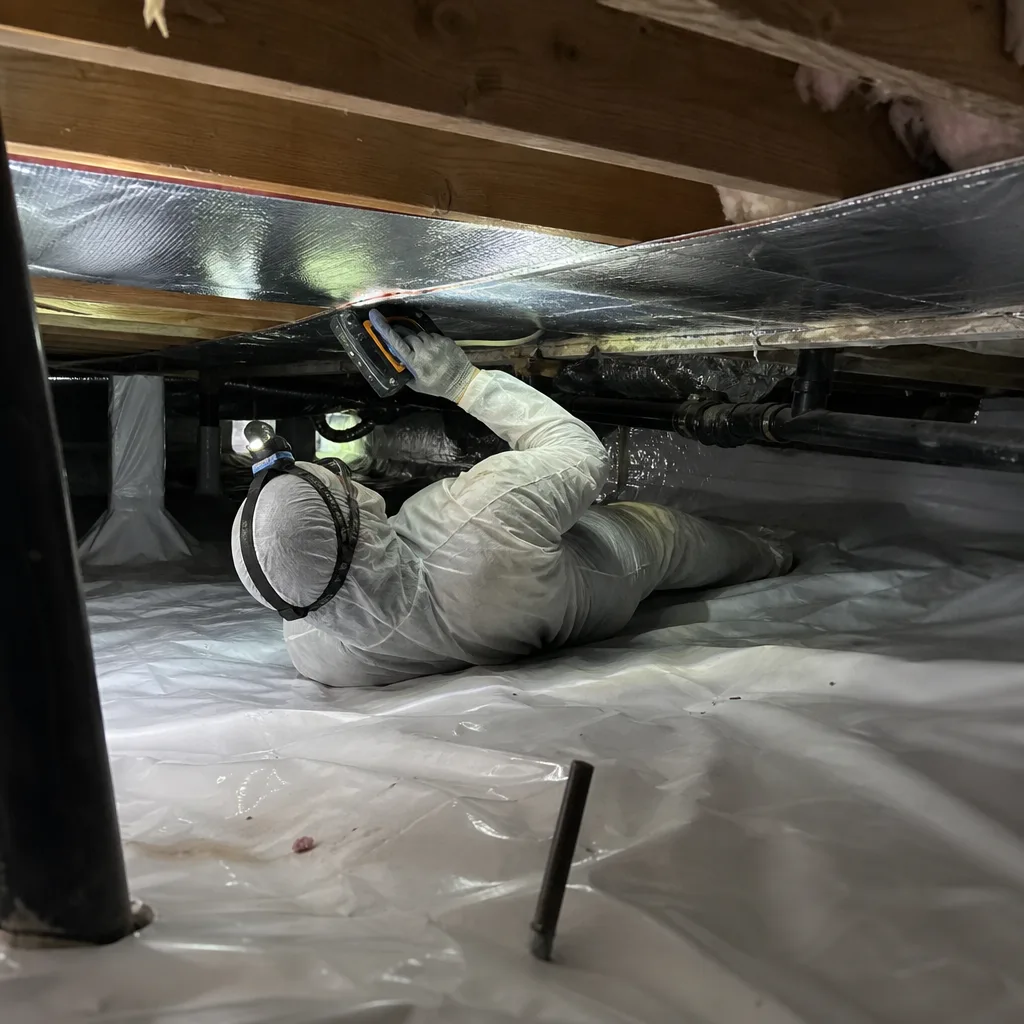
- 1
Moisture mapping and blower-door baseline. We run a blower-door depressurization test - which measures how much conditioned air your house leaks per hour - to establish whether the crawl space is connected to the conditioned envelope through bypasses. We also record relative humidity at three crawl space points and photograph existing GreenFiber condition.
- 2
Written price and scope delivery. Under Haven Standard Clause 1, you get a flat price, written scope, and written warranty before anyone lifts a tool. No exceptions. This includes our parts decision: OEM GreenFiber replacement stock when available, or quality aftermarket from Owens Corning, Johns Manville, or Knauf when the original specification no longer serves the actual conditions.
- 3
Extraction and air sealing. We remove compromised GreenFiber material, seal rim joists and penetrations with closed-cell foam or acoustic sealant as appropriate, and address any top-plate leakage that connects the crawl space to attic bypasses. This is the “sealed first” principle - insulation over unsealed air leaks is money spent twice.
- 4
Vapor barrier installation and insulation replacement. Reinforced polyethylene vapor barrier, cross-lapped seams, butyl-tape sealed, terminated 6 inches up foundation walls. New insulation installed to manufacturer spec for the actual moisture conditions, not the original design assumptions.
- 5
Post-work documentation. Documented Photo Record of all accessible areas, final humidity readings, and on applicable jobs, a second blower-door test showing the air-sealing improvement. You keep the printed report; we keep the digital backup.
- 6
365-Day Done Right Promise activation. If moisture returns or the vapor barrier fails at seams, we make it right. The promise is in writing before we start.
What GreenFiber Crawl Space Encapsulation & Vapor Barrier Costs in Yorba Linda
| Scenario | Typical Range | What Moves the Price |
|---|---|---|
| Standard crawl space (800-1,200 sq ft), vapor barrier replacement only, GreenFiber above intact | $2,800-$3,400 | Accessibility, soil condition, need for mold remediation |
| Full encapsulation with GreenFiber extraction and replacement, sealed vents, rigid foam perimeter | $4,200-$6,800 | Crawl space height, linear feet of foundation wall, dehumidifier inclusion |
| GreenFiber extraction from saturated subfloor bays, drying period, new vapor barrier, re-insulation | $3,600-$5,200 | Extent of borate washout, sheathing damage, need for structural repair |
| Conditioned crawl space conversion (sealed vents, supply air, dehumidifier, full thermal boundary) | $7,500-$11,000 | HVAC tie-in complexity, existing duct condition, permit requirements |
These ranges reflect actual Yorba Linda jobs we’ve completed in the Savi Ranch corridor and the older neighborhoods near Yorba Linda Regional Park. Hillside access, tight crawl spaces under 18 inches clearance, and homes with previous pest damage push toward the higher end. We also service Reflectix radiant barrier systems when they’re part of the same envelope upgrade.
Call (909) 323-1675 for a free estimate - we bring a written price to the visit, not a sales pitch.
Why Yorba Linda Homeowners Call Topside Attic Insulation Yorba Linda for GreenFiber Work
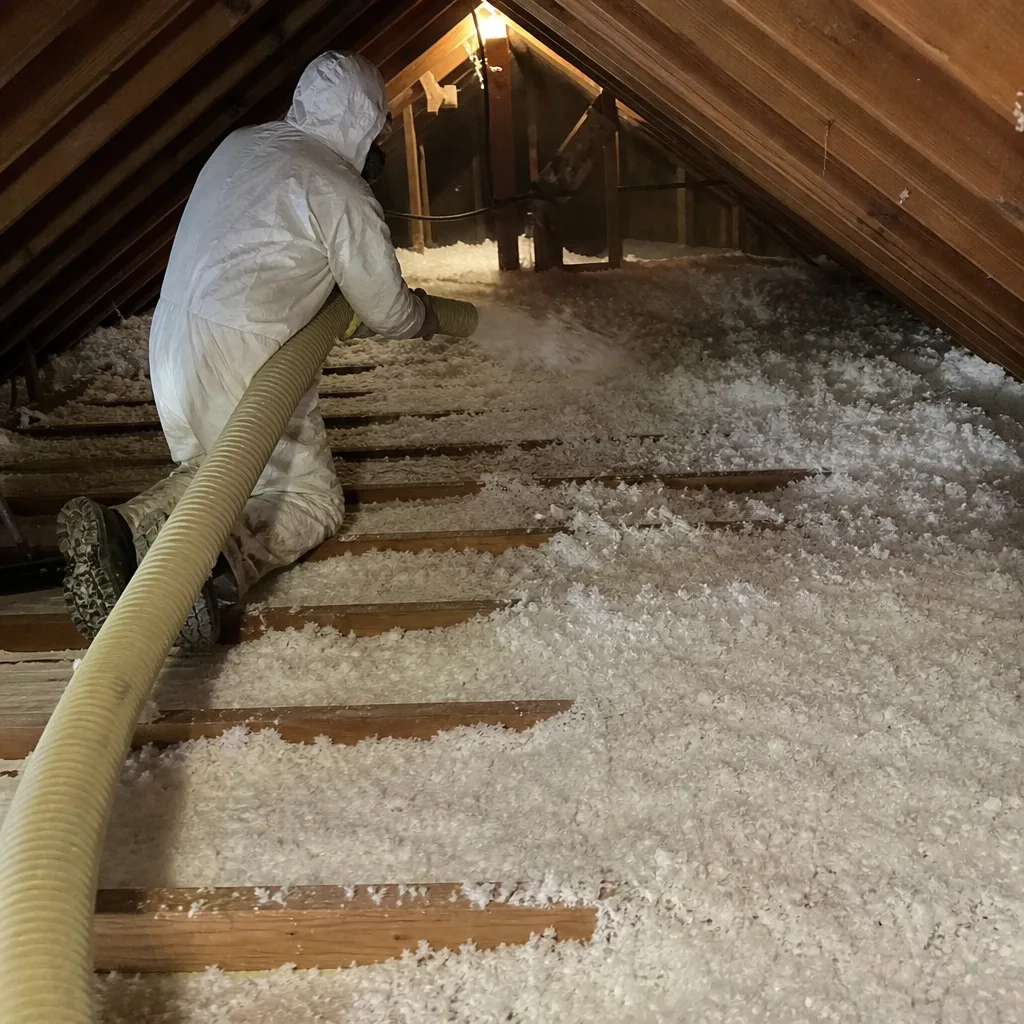
We’ve sealed and insulated over 9,000 homes since 2016, and the ones in Yorba Linda taught us specific lessons: the marine layer pushes moisture inland farther than most contractors account for, and the hillside homes off Bastanchury Road need perimeter drainage considered before any vapor barrier goes down. Wes Okafor runs every crew with the same standard - blower-door numbers published, photo record delivered, written price honored.
Our technicians are background-checked and uniformed; calls are answered by a live person, 24/7, no voicemail loops. We carry GreenFiber, Owens Corning, Johns Manville, Knauf, Rockwool, and Reflectix materials, so the solution matches your house, not our inventory. The 365-Day Done Right Promise applies to all completed work, and the Haven Standard requires that you have everything in writing before we start.
FAQs
GreenFiber’s product warranty covers manufacturing defects, not installation; our work carries its own 365-Day Done Right Promise and does not interact with GreenFiber’s material warranty unless we specify otherwise in writing. If your concern is a product defect, we document it and advise on manufacturer contact. Call (909) 323-1675 and we’ll review your specific situation.
Most jobs are completed in one to two working days; conditioned crawl space conversions with HVAC modifications may take three to four days. We schedule within 48 hours of written approval, and you’ll get a text when your technician is en route. For urgent moisture issues in Yorba Linda’s spring season, same-day starts are often available.
Repair makes sense when the vapor barrier is localized failure (torn seams, displaced at perimeter) and the GreenFiber above is dry and at proper density. Full encapsulation is the better investment when relative humidity chronically exceeds 70%, when borate washout is visible, or when the crawl space connects to attic bypasses that drive stack-effect moisture migration. We give you both prices and our honest read - the Haven Standard requires it.
Yes. R-value is a measured thermal resistance, not a brand property. We can match or exceed GreenFiber’s rated performance with Owens Corning, Johns Manville, Knauf, or Rockwool products, and we publish the blower-door numbers that prove the assembly works as designed. Some Yorba Linda homeowners prefer to stay with GreenFiber for material consistency; others switch based on moisture conditions. We stock both paths.
You receive a Documented Photo Record of all work areas, post-installation humidity readings at the same three points we measured initially, and on applicable jobs, a second blower-door test showing reduced envelope leakage. If the numbers don’t improve, we don’t consider the job complete. The 365-Day Done Right Promise covers any callback at no charge.
Written by Wes Okafor, Owner, Topside Attic Insulation Yorba Linda at Topside Attic Insulation Yorba Linda, serving Yorba Linda and nearby areas.